

Unifying headers across Platforma’s workflows
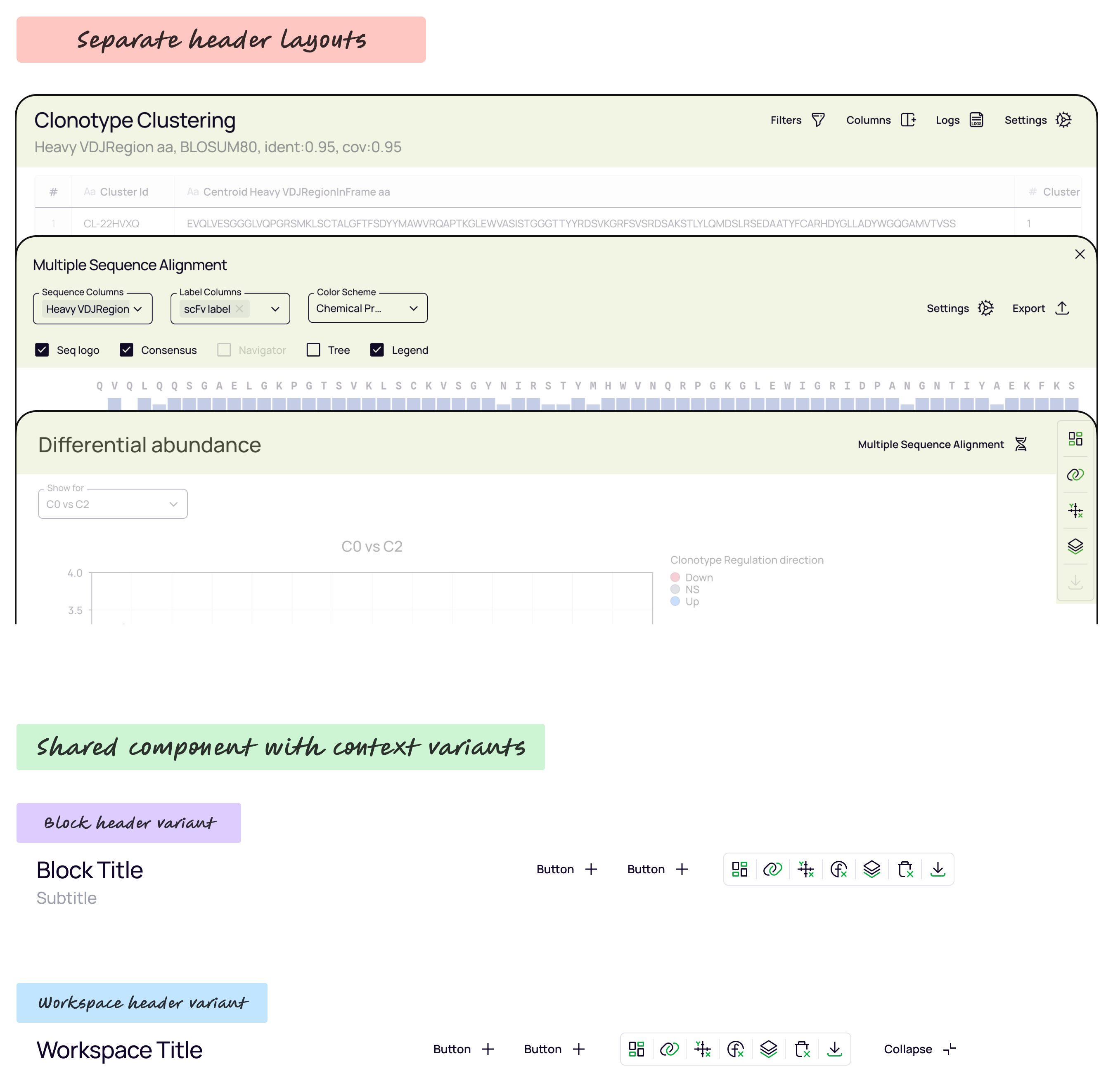
Platforma’s table blocks, charts, dialogs, and sheets had accumulated different header layouts and usage rules. With a new sequence-analysis workspace on the way, I initiated a redesign around a shared header component with variants for different contexts.
- Product
- Platforma — biological data analysis software by MiLaboratories
- My role
- Sole product designer; initiated and led the redesign
- Scope
- Shared header component, context variants, behavior specifications, documentation, and implementation review
- Collaboration
- Engineers and stakeholders
- Timeline
- Approximately five days for the redesign and discussions, alongside other tasks
- Status
- Shipped across all blocks, workspaces, dialogs, and sheets; available to SDK developers
Establishing a shared structure
Existing headers differed in control placement, spacing, and padding. The upcoming multiple sequence alignment (MSA) workspace added another context to support. I proposed a shared component that internal teams and developers using Platforma’s SDK could reuse.
I defined a consistent structure for titles, supporting information, and controls, with variants that adapted to each context. For blocks and fullscreen workspaces, the specification made those differences explicit: the workspace variant included a collapse action and adjusted spacing while retaining the shared structure.
Configuration-based subtitles already existed in Platforma. I preserved their optional, user-editable behavior as part of the header specification.
Defining behavior when space is limited
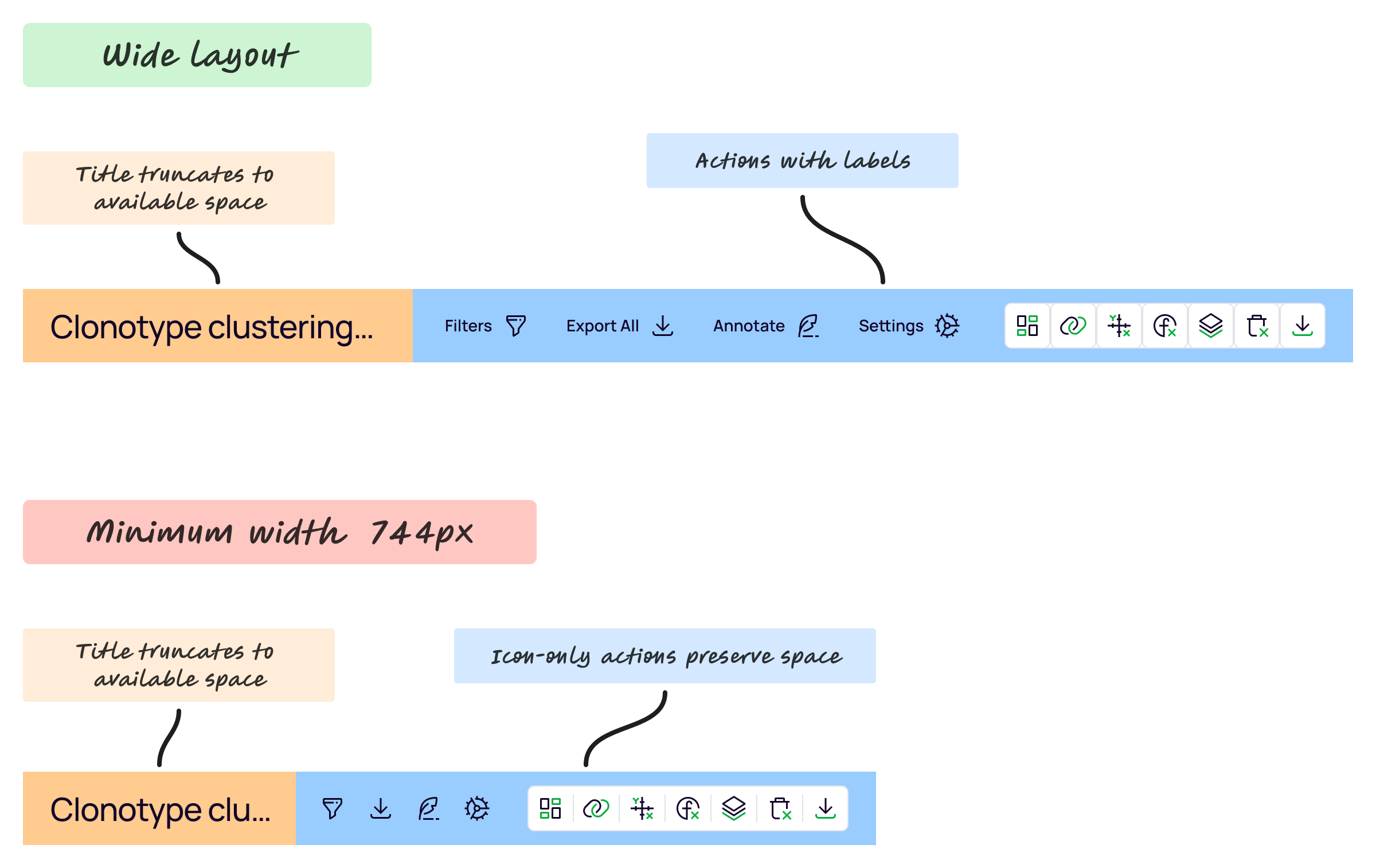
Block titles could be long, and the number of actions varied between tools. I worked through layout alternatives with engineering and documented how the header should allocate space.
The title used the space available before the controls and truncated to one line when necessary. Controls fitted their content and could not be pushed out of the header row by a long title. In the compact layout, action buttons switched to icons without labels to preserve space. Optional subtitles also remained on one line.
For block and workspace headers, the minimum width matched Platforma’s 744px working-area minimum. Below that width, the surrounding container handled horizontal scrolling. This kept the header row’s height and control layout predictable, with scrolling as the trade-off on narrower views.
Documenting, shipping, and reviewing
I documented the component’s structure, variants, optional content, sizing, and overflow behavior in an implementation ticket. Engineers used it alongside direct discussions throughout development. I reviewed the implemented result and worked with them on corrections.
The redesign shipped across all blocks, workspaces, dialogs, and sheets. Developers subsequently built working blocks without asking me for clarification about header usage — an encouraging practical signal, although I did not collect formal feedback or measure development speed.
The delivered result was a shared header component with documented usage rules, adopted across Platforma and available to SDK developers.