Scaling Platforma from startup website to enterprise product platform
Platforma had grown from a startup product into a complex ecosystem of scientific workflows, deployment options, and developer tools. The website no longer reflected the scale of the platform or helped visitors understand how its components fit together.
Context
Platforma had evolved beyond its original positioning.
The company was no longer an early-stage startup with a small set of capabilities. The platform had expanded into a comprehensive ecosystem including:
- multiple scientific workflows
- deployment options
- SDK and extensibility
- enterprise infrastructure
- academic and commercial audiences
The existing website no longer reflected the maturity of the product.
Information was difficult to navigate, product capabilities were fragmented across pages, and the overall experience did not communicate the scale of the platform.
Challenge
Platforma had grown into a broad ecosystem of scientific workflows, platform capabilities, deployment options, developer tools, and resources — but the website did not communicate how these pieces connected.
The challenge was to create an information architecture that could represent the product as one coherent platform while remaining understandable to audiences with different goals and levels of technical expertise.
Design principles
Design the product ecosystem, not individual pages
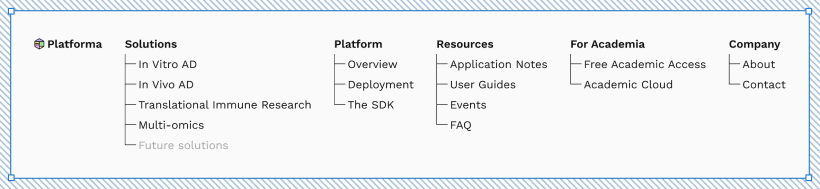
The website was treated as a connected product ecosystem rather than a collection of marketing pages.
Content was organized around:
- Solutions
- Platform
- Resources
- Company
This structure helped visitors understand how individual capabilities relate to the broader platform.
Make complex technology understandable
Platforma includes concepts that are unfamiliar to many visitors:
- deployment architecture
- enterprise infrastructure
- SDK and extensibility
- scientific workflows
Rather than burying these concepts inside marketing content, the redesign introduced dedicated platform pages that explain how the system works and how its components relate to one another.
This allows visitors to learn the system progressively and build a clearer mental model of how the platform works.
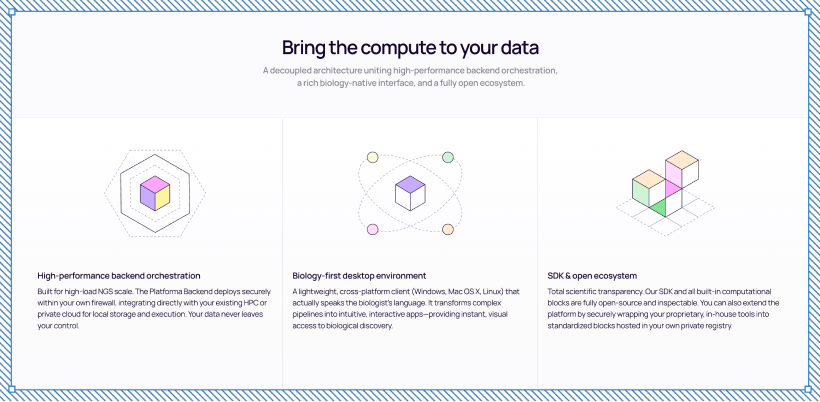
- The Platform Overview page transformed a complex technical architecture into a simple mental model built around infrastructure, user experience, and extensibility.
Organize content around user goals
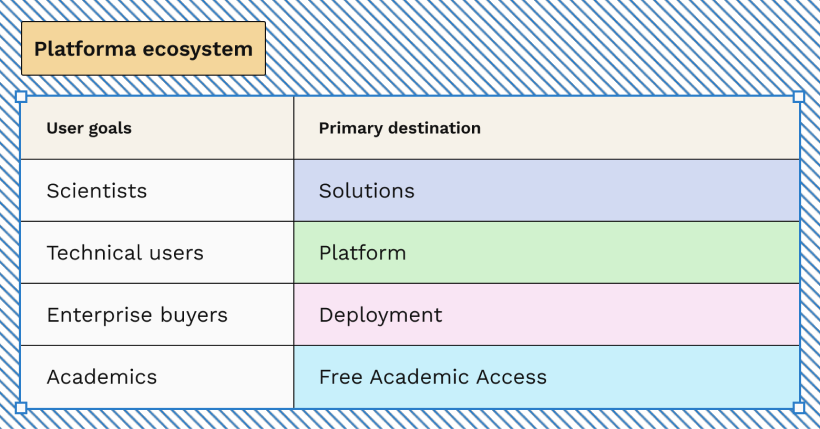
Visitors arrive with different intentions.
The website needed to support:
- scientists evaluating solutions
- technical users exploring platform capabilities
- enterprise buyers assessing deployment options
- academic users requesting access
Information architecture was designed around visitor intent rather than internal company structure, helping different audiences quickly reach the content most relevant to them.
Build trust through transparency
Enterprise customers need confidence before engaging with a platform.
The redesign introduced dedicated pages explaining:
- deployment models
- infrastructure options
- security considerations
- platform architecture
- open ecosystem principles
Rather than hiding these topics inside marketing content, the redesign made them visible and understandable.
This reduced ambiguity and helped visitors evaluate whether Platforma could fit their technical and organizational requirements.
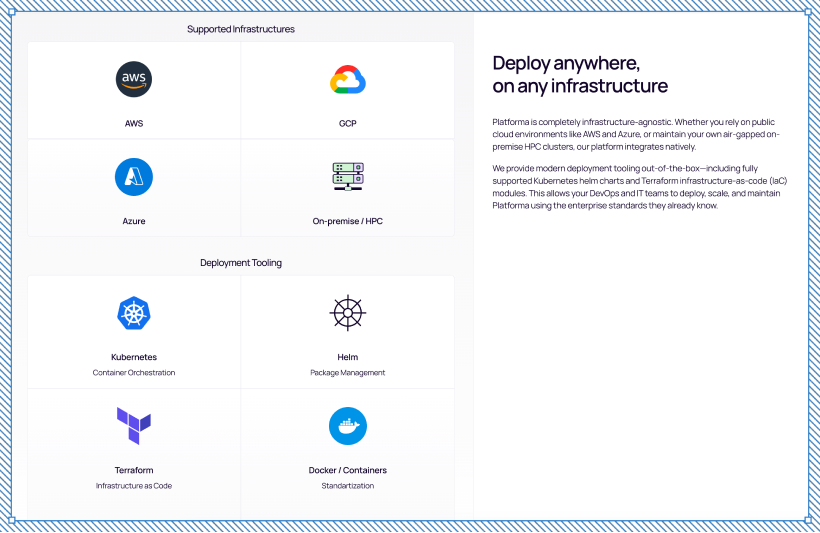
- Dedicated platform and deployment pages made infrastructure, deployment options, and operational requirements transparent, helping enterprise teams evaluate Platforma with confidence.
Why it mattered
- Unified a fragmented product ecosystem into a coherent platform story.
- Reduced the gap between scientific workflows, platform capabilities, and deployment infrastructure.
- Made enterprise requirements visible and understandable.
- Created a scalable information architecture capable of supporting future solutions and platform growth.
My role
- Led the redesign of Platforma’s website from information architecture through final UI design.
- Defined the platform information architecture, navigation model, and page hierarchy.
- Designed key product communication pages including Platform Overview, Deployment, SDK, Solutions, and Resources.
- Established a scalable structure capable of supporting future products, workflows, and platform growth.
- Collaborated with leadership, marketing, and engineering teams to align product messaging with business goals.
Outcome
The redesign transformed Platforma’s website from a collection of product pages into a structured platform ecosystem.
The new information architecture:
- connected scientific workflows, platform capabilities, and deployment infrastructure into a coherent story
- made technical and enterprise concepts easier to discover and understand
- created dedicated entry points for scientists, technical users, enterprise buyers, and academic researchers
- established a scalable foundation capable of supporting future solutions and platform growth
The result was a website that communicates Platforma as a unified product ecosystem rather than a collection of individual features, creating a foundation that can scale alongside the product itself.